


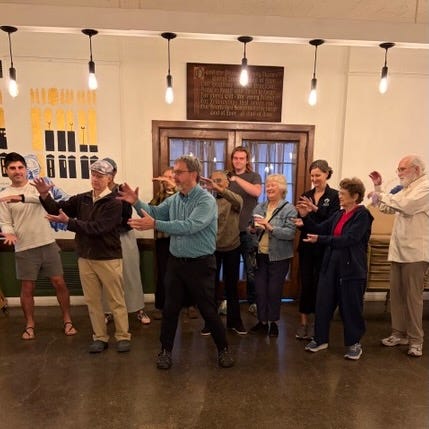
In my first post, I explained why I call myself a village teacher. This one is about the name of the group I teach, because I chose each of its three words for a reason.
The bamboo bends; the oak breaks. Resilience is not the absence of difficulty. It is the capacity to move with it and return.
The most useful names point beyond themselves, toward the living thing they are trying to call into being. Resilient Community Qigong has a story, and it says a lot about what we do when we practice together.
A Moment That Called for Something
The group began in early 2025, when change felt relentless, and many people felt unsettled. In that moment, the community at University Church in Hyde Park asked a simple question: what can we offer one another? I proposed Qigong out of two needs felt at once. One was personal: a practice that could keep me steady inside through ongoing difficulty. The other was shared: to do that work together rather than alone.
Turning to a Very Old Practice
Qigong, known for much of its history as dao yin (“guiding and stretching”), has roots reaching back thousands of years. Its history is not a smooth, uninterrupted story of teaching. It is a history of suppression and survival: texts lost, communities scattered, practitioners persecuted. During China’s Cultural Revolution, many of these practices were forbidden, and people kept them alive quietly, within families and in their own bodies.
The practices survived because they are held in bodies and between people, not in buildings or books alone. That history raised a question at the heart of this group: can this tradition help us now not only get through hard times, but thrive in them? History suggests it can, with one consistent condition: it works best in community.
Three Words, One Intention
Resilient: building the capacity to absorb, adapt, and continue. Not by hardening, but by learning to move like bamboo in wind.
Community: resilience built alone is more fragile than resilience built together. Community is both the setting and the purpose of the work.
Qigong: a living tradition with roots in ancient Chinese healing and shamanic practice, shaped by Daoism, Buddhism, and Confucianism, and now in conversation with Western medicine and science. We are not inventing something new; we are joining something very old.
What You Are Joining
When you practice with us, you join a thread that runs through a long history of human difficulty and adaptation. The people who kept this tradition alive were not superhuman. They were people much like us, practicing together to stay whole in times that threatened to pull them apart.
What we practice, week after week, is the pause: the moment between what happens and how we respond. Within change, a pause; from the pause, the next step. Doing that in a room with others makes it easier to find the pause and remember when we are on our own.
Try it today
Stand with your feet about hip-width apart and let your knees soften. Take three slow breaths, letting each exhale run a little longer than the inhale. Notice what settles. If you practice with others this week, watch for one moment when the whole room settles together.
Next time: what the words qi and Qigong actually mean, and how to hold them without having to believe anything first.
Practice with us
Free weekly class: Wednesdays, 10 AM, University Church, 5655 S. University Ave., Chicago.
Classes at Bodhi & Sage Wellness Community: 1525 E. 55th St., 3rd Floor, Chicago.
Schedule and registration:
https://www.bodhiandsage.com
This post does not constitute medical advice. It is offered for educational and wellness purposes only. Please consult a qualified healthcare provider before beginning any movement, breathing, or meditation practice.
Curated and directed by C. Havens · Researched and drafted by Claude (Anthropic), under Charlie’s direction.