


Is qi real?
It’s one of the first things people want to know about qigong, and it’s a fair question. The word comes up in every class. Teachers talk about qi flowing, gathering, sinking to the Dan Tian. If you come from a world of lab results and spreadsheets, as many of us do, it’s natural to ask whether anything is there.
There are two easy answers. One says qi is a subtle energy, as real as electricity, and the meridians are its wiring. The other says it’s all suggestion: you feel warmth because someone told you to expect it. I don’t find either one honest. The first claims more than anyone can show. The second throws out what people actually experience, along with a good deal of research.
Here is how I’ve come to hold it.
The territory
Start with what happens when you practice. Warmth gathers in the low belly. A wave of ease moves down the arms. Near the end of a set, something settles. In a room of people practicing together, there’s a shared quiet you can almost touch. Over weeks, many people notice a returning sense of aliveness.
That lived experience, what I’ve come to call aliveness, is the territory. It’s real, and it’s the ground everything else refers to.
So are the benefits. Decades of research, including randomized controlled trials, show that qigong and tai chi improve balance and lower the risk of falls, ease stress, and help the nervous system shift toward calm. Those outcomes aren’t in doubt.
The maps
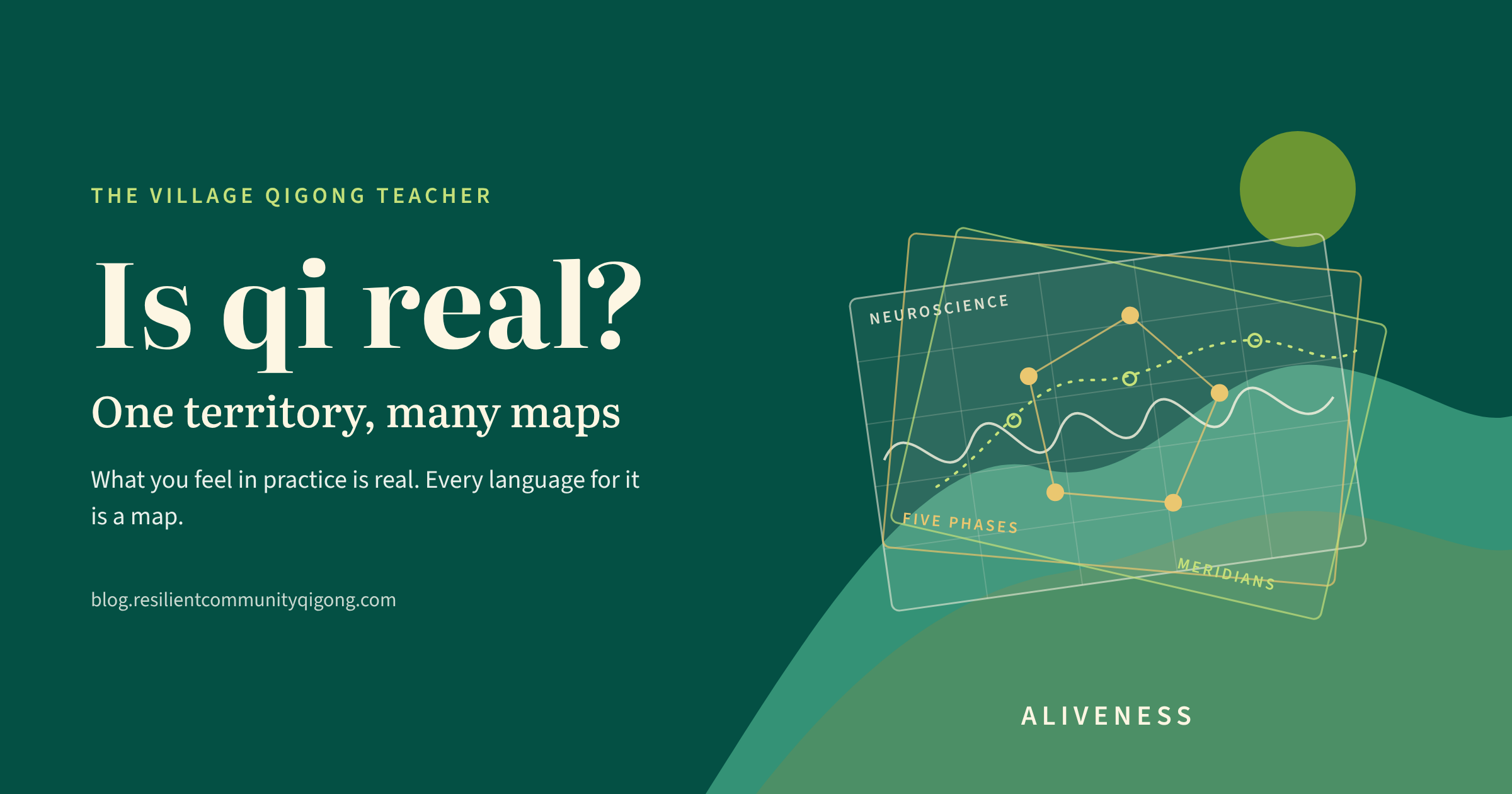
Then there are the languages we use to describe what’s going on. Traditional Chinese medicine and Daoism offer qi, the meridians, Yin and Yang, and the Five Phases (Wu Xing). Modern science offers the vagus nerve, the fascia, the chemistry of breath, and the brain’s sense of the body from the inside. Our course adds a couple of maps of its own.
Each of these is a map, and a map is not the land. It’s a way of naming what the practice is made of, what it develops in you, and why it has long been understood to work. The old Buddhist image fits: every map is a finger pointing at the moon. Don’t mistake the finger for the moon.
The maps don’t have to compete. The lower Dan Tian sits in the same region as part of the gut’s own nervous system. That’s a correspondence, not an identity: one map doesn’t swallow the other. Heart rate variability rises with practice, and that’s a sign of the calming, not its cause. Hold every map that way, and you can speak tradition and science in the same breath without forcing one to become the other.
A word bigger than a feeling
In Chinese, qi is a much bigger word than “energy.” It’s breath, and it’s weather. It’s the mood of a room, the life in a brushstroke, the vitality you see in someone’s face before they say a word. Much of it is noticed in other people and in the world, not only felt inside your own body. That’s why I call the territory lived experience, not just a feeling.
I also stop there on purpose. Chinese cosmology says everything is made of qi. Maybe so. I don’t know, and I don’t need to know in order to practice. What I can stand on is what practice keeps showing me. I call this Mindful Not Knowing: staying honest about what is unknown, and finding it interesting rather than embarrassing.
The long experiment
Where did the forms come from? Not from a laboratory. The Eight Pieces of Silk Brocade, the Five Animal Frolics, standing practice: these reach us because generation after generation found them useful, refined them, wrote them down, and tested them again in their own lives. Qigong has more than 2,000 years of written record behind it.
That’s its own kind of evidence. Not the controlled trial, but the long experiment of many lives. Modern research is a third witness, arriving late to a conversation already centuries deep.
Not “anything goes”
“Many maps” is humility about explanations only. It’s never doubt about the experience or the benefits. The maps are plural and provisional; the territory is not. I hold the results with confidence and the explanations with an open hand.
How to hold the maps
You don’t need any of them for the practice to work. People practiced these forms for centuries without a word about the vagus nerve, and plenty of people practice today without a word of Chinese theory. Use the maps the way you’d use a good pair of glasses: put them on when they help you see, and take them off when you’d rather just look.
Try it this week: Practice once with a map in mind. Follow the breath down toward the Dan Tian, or notice your shoulders letting go as your nervous system settles. Then practice once with no map at all. Just notice what you feel, and when. See which day teaches you more. Most of us find we need both.
So, is qi real?
My honest answer: what the word points to is real enough to stand on. The warmth, the settling, the steadier balance, the quiet of a room breathing together. What qi ultimately is, I hold open. That question is one of the things the practice keeps handing me, and I find it more interesting than any answer would be.
Every map is a finger pointing at the moon. Keep practicing, and keep looking at the moon.
Nothing shared here is medical advice. It’s offered for educational and wellness purposes only. Please consult a qualified healthcare provider before beginning any movement, breathing, or meditation practice.
Curated and directed by C. Havens · Researched and drafted by Claude (Anthropic), under Charlie’s direction.