

A change of plan: last week I promised a post on Overreach, about what practice can and can’t promise. It’s coming next week. This one jumped the line. Paul Cavel’s series on meditation arrived just as our class is turning toward meditation, and I wanted to think it through in writing first, so I can bring its language into class over the coming weeks.
How much of your last meditation were you actually there for?
A teacher I learn from put that question in my head this month. In a four-part series that finished this week, Paul Cavel suggests that in an hour of “meditating,” a person may be truly present for five minutes, maybe less. Whoa, embarrassingly, he was talking about me. It describes my own morning practices, moving in and out of presence. Then I felt relieved. If drifting is normal, then coming back is the practice.
Who Paul Cavel Is
Paul Cavel teaches Qigong, Tai Chi, bagua, and Daoist meditation through The Tai Chi Space. He is a longtime student of, and a senior instructor for, Bruce Frantzis, and teaches in the Water Method line of Daoist practice, which Frantzis brought to the West from his teacher Liu Hung Chieh. I was first introduced to the Water Method by Chris Cinnamon, in his Chicago Tai Chi classes; Chris studied under Frantzis. That approach runs all through what I teach. The seated meditation we do in class, with attention resting in the feet, comes from Paul, and so does much of how I think about softening instead of forcing. I’ve encountered him through his book, Taoism: A Journey Towards Unity, as co-author of Heaven and Earth Qigong: Heal Your Body & Awaken Your Qi, and through his online courses and writings.
His series, Meditation: The 4 Primary Skills, is the clearest short account of meditation I’ve read. Please read it in his own words: Part 1: Making the Body Conscious, Part 2: Expanding Your Awareness, Part 3: Creating a Stream of Consciousness, and Part 4: Entering Into Wu Wei. Here is what I took from it, and how it fits what we practice in Resilient Community Qigong.
Four Skills, Each Built on the One Before
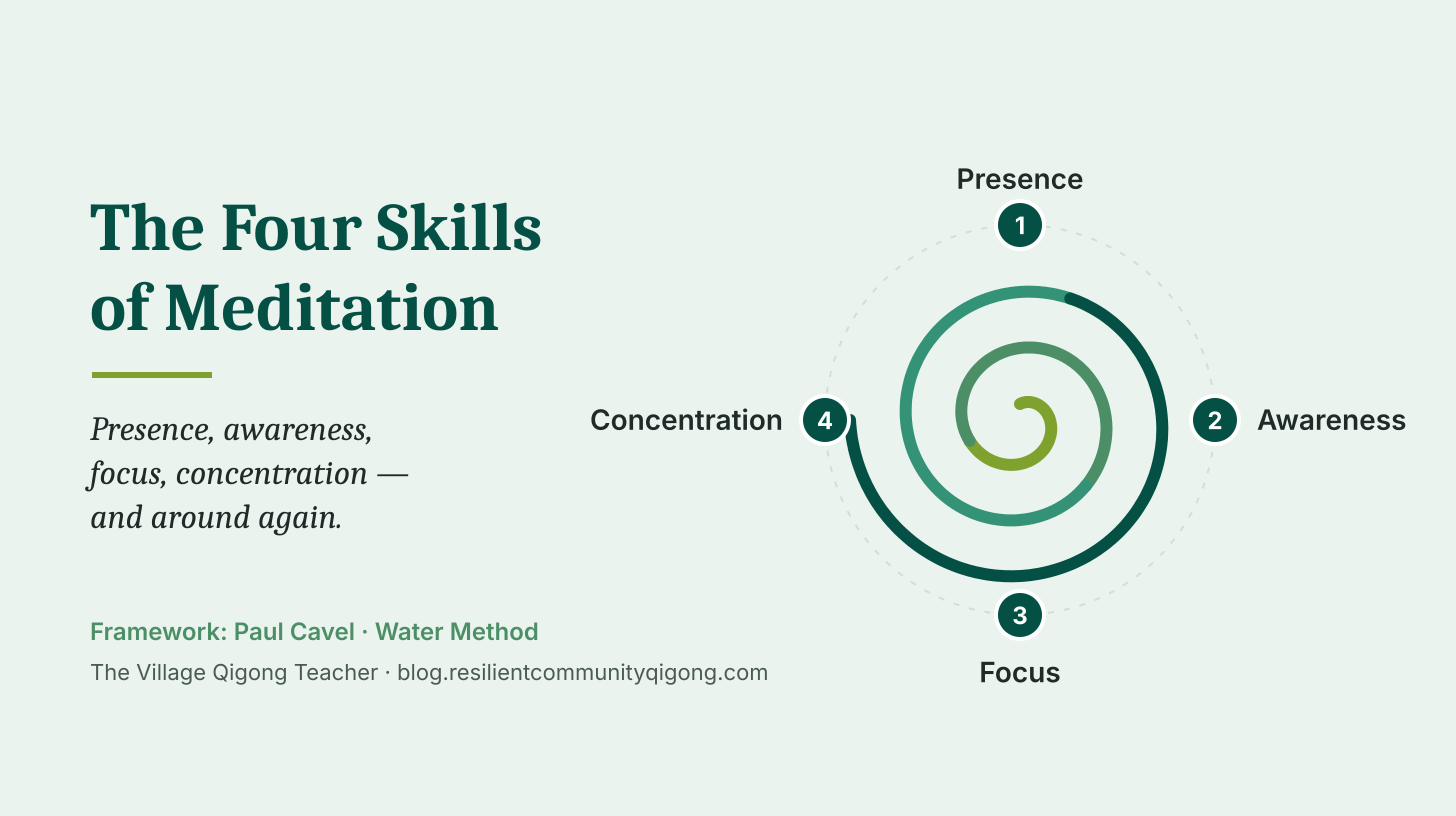
Cavel starts with a plain point: thinking about something is not meditating, whatever your reason for sitting down. Four skills decide what meditation actually does for you:
Presence: being here, now.
Awareness: knowing what is actually happening.
Focus: guiding your attention to what you choose.
Concentration: staying with it, so attention flows like a stream instead of flickering.
Each grows out of the one before. You can’t be aware while you’re spacing out, and you can’t focus on what you haven’t noticed.
Two ideas from the series have already changed how I teach.
The anchor. When the mind starts swinging between the past and the future, Cavel’s tradition doesn’t ask for more willpower. It gives the mind a place to rest: the body itself. Feel your feet. That’s the anchor.
Soft focus. Most of us learned to concentrate by gripping: squint, push everything else away, try harder. Cavel describes the opposite. Guide the mind gently to one thing, let the rest go, and when it wanders, guide it back just as gently. The softer the focus, the more the body relaxes, and the longer the focus lasts.
Around and Around
The part I find most generous is the shape of the learning. The skills, Cavel says, aren’t a ladder. You work on presence until you notice a little progress, then awareness, then focus, then concentration, and then you come back to presence, which the other three have deepened. Even very experienced practitioners return to the beginning. He says it’s more like a spiral: the same place, but never quite the same.
That’s how our year-long course is built, too. We spend four weeks at a time on each of twelve ways of working with qi, and we describe it as a circle, not a ladder: we keep coming back to pick up what we touched before. It was good to see a teacher I follow describe the same shape, inside a single sitting.
Easy Does It
In the final part, Cavel writes about tiny adjustments to posture, easy breathing, and the moment practice starts to feel effortless. He calls that the earliest taste of wu wei, which he translates as “achieving without effort.” He says what gets in the way is the drive to achieve. His advice is daily consistency without the strain of wanting, staying within a natural two-thirds of your capacity.
Two-thirds. In our classes, we call it the 70% Rule. I smiled when I read that one.
Why We Practice These Skills
Cavel’s tradition takes meditation a long way, toward deep letting go and, for some, union with the Dao. I hold that horizon with respect and curiosity, not promises. In our classes, the reason is closer to home. People come to us living through change: caring for someone, working for something, carrying the news. Presence, awareness, focus, and concentration are what the pause is made of, the moment between what happens and how we respond. Practicing them together, week after week, is how we stay healthy enough to respond.
Try it today: five minutes, four skills
Sit near the front of a chair, feet flat, spine tall and easy. Feel the soles of your feet.
Notice what is here, without changing anything.
Rest your attention softly on your feet and your breath.
When your mind wanders, notice and come back, kindly. Each return counts.
If you start to sag, make the smallest adjustment that brings back ease.
Finish with a long, soft “Haaa” out-breath.
Keep it easy, never more than about 70% of your effort. Your eyes can stay open. If turning inward ever feels uncomfortable, open your eyes, move, or stop.
What we know, and what stays open. Studies of meditation programs show modest improvements in anxiety, low mood, and pain, and regular Qigong practice supports balance, stress relief, and overall well-being. Research backs up Cavel’s honesty about drifting, too: in one large study, people’s minds were wandering during almost half of their waking moments. What stays open is exactly how practice does its work, and what that first taste of effortlessness is. In class, we call holding that question Mindful Not Knowing.
Thank You, Paul
If this was useful, read the whole series, starting with Part 1 on paulcavel.com, and follow Paul Cavel’s teaching on YouTube, Instagram, and Facebook. He has asked readers to share the series to help more people find the Water Method. I’m glad to.
Next week, as promised: Overreach. Cavel is honest that most of an hour’s sitting is spent drifting. Next week, the same honesty about results: when you recover with the help of many things at once, how much credit does any one of them get?
Practice with us
Free weekly class: Wednesdays, 10 AM, University Church, 5655 S. University Ave., Chicago.
Classes at Bodhi & Sage Wellness Community, 1525 E. 55th St., 3rd Floor, Chicago: schedule and registration coming soon.
Nothing in this post constitutes medical advice. It is offered for educational and wellness purposes only. Please consult a qualified healthcare provider before beginning any movement, breathing, or meditation practice.
Curated and directed by C. Havens · Researched and drafted by Claude (Anthropic), under Charlie’s direction.